A properly installed fresh or waste-water tank makes a campervan easier to use while freeing up valuable storage space inside the conversion.
WeConvert arranges campervan water-tank installation near Huddersfield, West Yorkshire, for customers across Yorkshire, Lancashire, Greater Manchester and across the North of England. Underslung, internal and wheel-arch tanks can be fitted in a wide range of vans, including the Peugeot Boxer, Fiat Ducato, Citroën Relay, Volkswagen Transporter, Ford Transit, Mercedes Sprinter and Volkswagen Crafter.
Our service ranges from securely mounting a customer-supplied tank to completing the filler, breather, drainage, pump and internal plumbing connections.
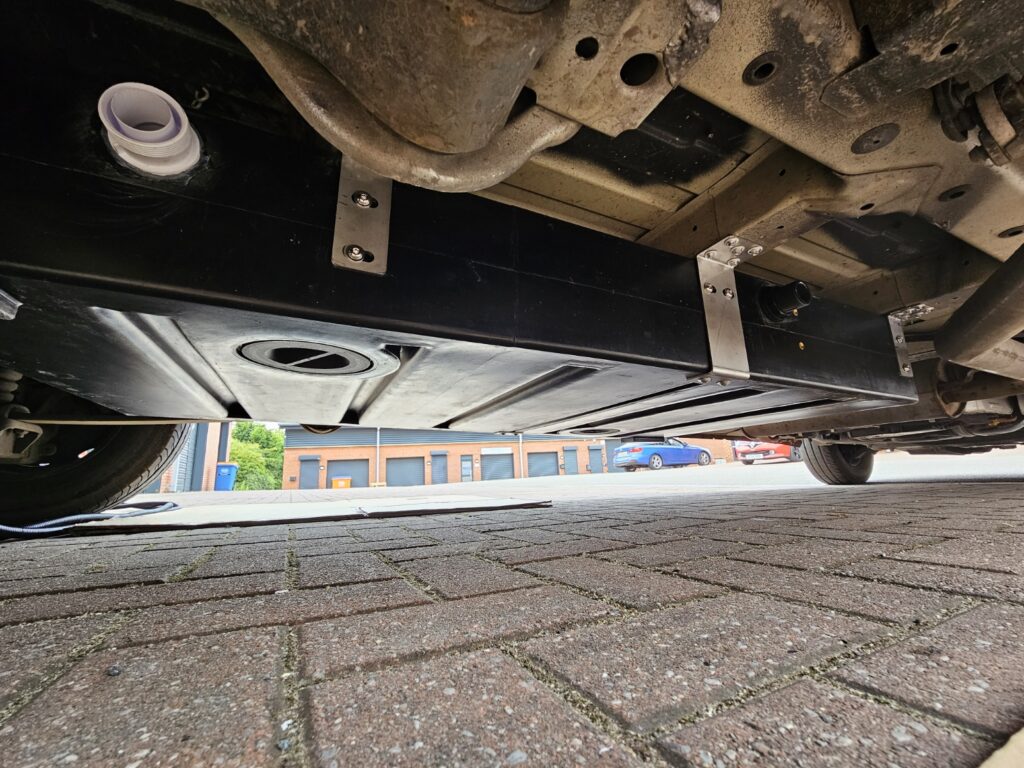
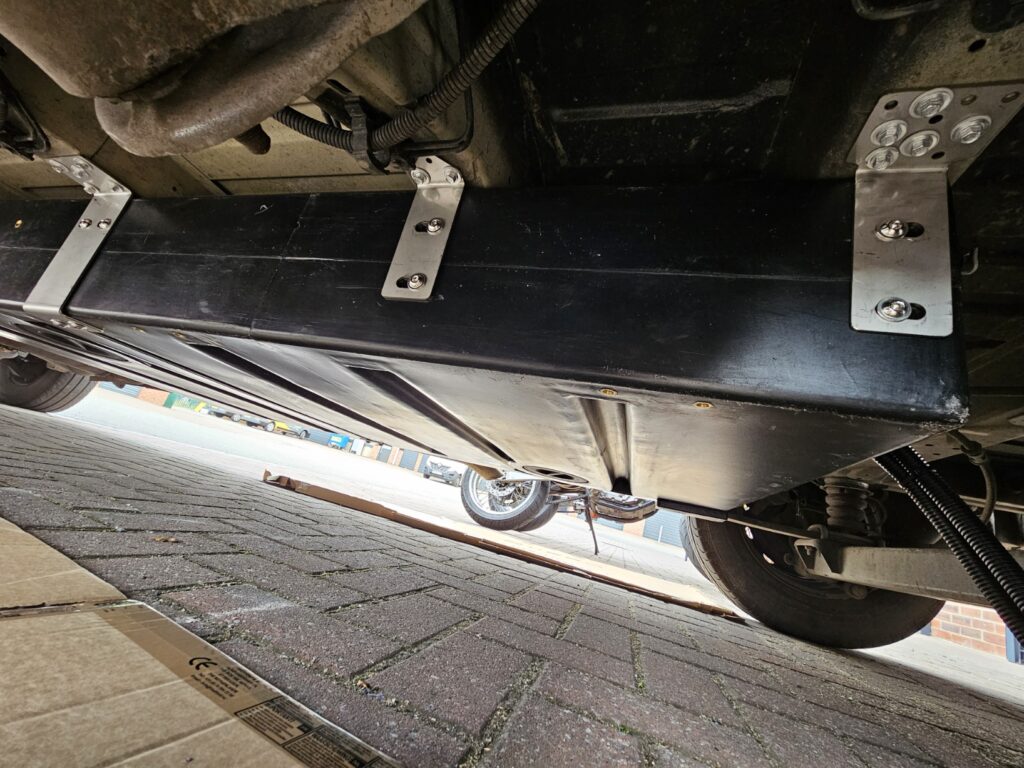
We have also installed an underslung water tank on our own Citroën Relay campervan, giving us first-hand experience of tank positioning, bracket installation, underbody clearance and plumbing on the Boxer, Ducato and Relay platform.
Fresh and waste water tanks, underslung, internal and wheel-arch, installed near Huddersfield, West Yorkshire, by appointment.
Tank and installation materials charged separately.
Fresh and Waste Water Tank Services
We can help with:
- Underslung fresh-water tank installation
- Underslung waste or grey-water tanks
- Internal fresh-water tanks
- Wheel-arch water tanks
- Tank mounting and support brackets
- External filler points
- Breather and overflow pipework
- Tank drain valves
- Fresh-water pumps and filters
- Accumulators
- Water-level sensors
- Sink and shower waste connections
- Existing tank replacement
- Leaking tank fittings
- Plumbing alterations
- Complete fresh and waste-water systems
Every installation is planned around the vehicle, intended use and equipment already fitted beneath or inside the van.
Fresh Water Tank Installation
A fixed fresh-water tank stores the clean water used by equipment such as:
- Kitchen taps
- Bathroom taps
- Showers
- Water heaters
- Toilets
- External wash points
A complete fresh-water installation may include:
- Fresh-water tank
- Suitable mounting system
- External or internal filler
- Breather and overflow
- Drain valve
- Tank outlet
- Pump inlet filter
- Water pump
- Accumulator where appropriate
- Hot and cold-water distribution
- Water-level sensor
The exact system depends on how the campervan will be used.
A simple weekend van with one cold tap may need a much smaller installation than an off-grid conversion with a shower, water heater and several outlets.
Mounting a Tank Only
The installer can mount a compatible customer-supplied tank using its vehicle-specific bracket kit.
This normally includes:
- Confirming the proposed location
- Checking underbody clearance
- Positioning the tank
- Installing suitable brackets and fixings
- Protecting drilled mounting points where required
- Checking that the tank is secure
- Confirming clearance from moving or hot components
Mounting only does not include the filler, breather, outlet, pump, drainage or internal plumbing unless these are specifically added to the quotation.
Complete Fresh-Water Tank Installation
A complete installation may also include:
- External gravity filler
- Large-diameter filler hose
- Tank breather
- Overflow
- Drain valve
- Pump outlet connection
- Pump inlet filter
- Water-level sender
- Connection to existing internal pipework
- Filling and leak testing
The customer should explain whether they require physical tank mounting or a complete functioning water system when requesting a quotation.
Waste and Grey Water Tank Installation
A waste-water tank collects used water from:
- Kitchen sinks
- Washbasins
- Showers
- Utility sinks
This is generally known as grey water.
A properly designed waste system needs more than a plastic tank and a length of hose.
The installation should consider:
- Waste-pipe diameter
- Natural fall towards the tank
- Tank ventilation
- Drain-valve position
- Access for cleaning
- Ground clearance
- Protection from road damage
- Exhaust heat
- Frost protection
- Odour prevention
- Future maintenance
Poorly routed waste pipes can retain water and debris, leading to slow drainage and unpleasant smells inside the vehicle.
Where practical, the tank drain should be accessible without requiring the owner to crawl beneath the centre of the van.
Underslung Water Tanks
An underslung water tank is mounted beneath the vehicle.
This preserves valuable storage space inside the campervan and can allow a larger volume of water to be carried.
Advantages can include:
- More space beneath beds and seating
- Less internal furniture space occupied
- Larger tank-capacity options
- Separate fresh and waste tanks
- A neat permanent installation
- Easier integration into large panel-van conversions
However, an underslung tank must be positioned carefully.
The available space may be affected by:
- Exhaust system
- Fuel tank
- AdBlue equipment
- Handbrake cables
- Brake lines
- Spare wheel
- Side steps
- Diesel heater
- LPG tank
- Suspension components
- Chassis members
- Jacking points
- Existing conversion wiring and plumbing
A tank advertised for a particular van does not automatically fit every vehicle of that model.
The year, wheelbase, drivetrain and existing equipment should be confirmed before the tank is purchased or booked for installation.
Internal Water Tanks
An internal fresh-water tank can be a better option where:
- The van will be used regularly during winter
- Underbody space is already occupied
- Ground clearance is limited
- Easier inspection is preferred
- The owner wants shorter pump pipework
- Freezing is a major concern
Common internal locations include:
- Beneath a fixed bed
- Inside a rear garage
- Beneath a bench seat
- Inside a kitchen unit
- Around a wheel arch
The tank must be securely restrained.
A full tank creates a significant moving load during braking and cornering. It should not rely only on lightweight furniture panels to keep it in place.
Wheel Arch Water Tanks
A wheel-arch tank is shaped to fit around an internal rear wheel arch.
This can be particularly useful in:
- VW Transporter conversions
- Ford Transit Custom conversions
- Small campervans
- Day vans
- Vehicles with limited underbody space
Advantages can include:
- Good use of otherwise awkward space
- Easier access to fittings
- Better frost protection than an exposed tank
- Shorter distance to the pump
- Reduced underbody installation work
The trade-off is that a wheel-arch tank occupies some internal space and may offer less capacity than a large underslung tank.
Peugeot Boxer, Fiat Ducato and Citroën Relay Water Tanks
The Peugeot Boxer, Fiat Ducato and Citroën Relay share a closely related base vehicle and are popular choices for campervan conversions.
Vehicle-specific underslung tanks are available, but the correct tank depends on factors including:
- Vehicle year
- L2, L3 or L4 body length
- Fresh or waste-water use
- Intended mounting position
- AdBlue equipment
- Exhaust position
- Spare-wheel arrangement
- Diesel-heater location
- LPG equipment
- Side steps and other conversion work
Information Needed for a Boxer, Ducato or Relay Quote
Please provide:
- Van make and model
- Vehicle year
- L2, L3 or L4 body length
- Tank product link
- Tank capacity
- Fresh or waste-water requirement
- Photographs of the tank and brackets
- Photographs beneath the intended fitting area
- Details of any diesel heater, LPG tank or side steps
- Whether mounting only or full plumbing is required
VW Transporter Water Tank Installation
The installer installs suitable fresh and waste-water tanks in Volkswagen Transporter campervans, including:
- VW T5
- VW T5.1
- VW T6
- VW T6.1
- Newer Transporter models, subject to tank compatibility
Transporters generally have less unused underbody space than larger Boxer or Relay conversions, so tank selection requires careful planning.
The available position may be affected by:
- Fuel tank
- Exhaust
- Spare wheel
- Diesel heater
- AdBlue equipment
- Side bars
- Suspension
- Four-wheel-drive equipment
- Existing conversion services
VW Transporter Tank Options
Depending on the vehicle and conversion layout, options may include:
- Vehicle-specific underslung fresh-water tank
- Underslung waste tank
- Internal wheel-arch tank
- Tank beneath rear seating
- Tank beneath a bed platform
- Compact kitchen-unit tank
- Fixed tank replacing portable water containers
An internal wheel-arch or furniture-mounted tank can be a sensible choice for Transporters used throughout winter.
An underslung tank may be preferable where preserving internal cupboard space is more important.
The tank should be selected for the exact vehicle generation and wheelbase. A product designed for one Transporter platform should not be assumed to fit another.
Ford Transit and Transit Custom
Water-storage options for Transit and Transit Custom conversions can include:
- Underslung fresh-water tanks
- Underslung grey-water tanks
- Internal wheel-arch tanks
- Bed-box tanks
- Kitchen-unit tanks
Transit Custom conversions often need compact tanks because of their lower body height and more limited underbody space.
The installation must account for the spare wheel, exhaust, diesel heater, side steps and any auxiliary electrical equipment beneath the vehicle.
Sprinter, Crafter and MAN TGE
Mercedes Sprinter, Volkswagen Crafter and MAN TGE conversions can often accommodate larger fresh and waste-water systems.
Possible options include:
- Underslung fresh-water tank
- Underslung grey-water tank
- Large internal garage tank
- Separate fresh and waste tanks
- Internal wheel-arch tanks
Compatibility depends on:
- Vehicle generation
- Wheelbase
- Front-, rear- or four-wheel drive
- Prop shaft
- Exhaust
- Fuel and AdBlue tanks
- Spare-wheel position
- Existing conversion equipment
Renault Master, Vauxhall Movano and Nissan Interstar
These vehicle names have been used across several different generations and shared platforms.
The correct tank should therefore be selected using the exact vehicle year, generation, wheelbase and underbody layout.
Options may include:
- Vehicle-specific underslung tanks
- Universal underslung tanks
- Internal tanks
- Wheel-arch tanks
- Separate waste-water tanks
Other Campervans
The installer can also assess tank installations for vans including:
- Vauxhall Vivaro
- Renault Trafic
- Nissan Primastar
- Peugeot Expert
- Citroën Dispatch
- Toyota Proace
- Mercedes Vito
- Iveco Daily
- Volkswagen Caddy
- Ford Transit Connect
- Custom-built and unusual conversions
Where a vehicle-specific tank is not available, a universal tank may still be possible.
Universal installations can require additional fabrication, mounting design or protective supports and are therefore quoted individually.
Choosing the Correct Tank Capacity
The correct tank size depends on:
- Number of occupants
- Length of trips
- Shower use
- Cooking and washing
- Access to campsite facilities
- Available payload
- Tank location
- Winter use
- Available charging and heating systems
- Fresh and waste-water balance
A larger tank does not automatically create a better system.
It also adds:
- More weight
- Longer filling time
- More structural load
- More water that may freeze
- Greater space requirements
Fresh and waste capacities should be considered together.
A very small waste tank may fill long before the fresh tank is empty, particularly where a shower is fitted.
Filler, Breather and Drainage
Fresh-Water Filler
A gravity-filled fresh-water system usually includes:
- External filler point
- Large-diameter filler hose
- Tank breather
- Overflow arrangement
The filler route must allow water to flow into the tank without trapping air or creating a low point where water remains.
Tank Breather
As water enters or leaves the tank, air must be able to move in the opposite direction.
A blocked or poorly routed breather can cause:
- Slow filling
- Water returning from the filler
- Pump performance problems
- Tank deformation
- Intermittent water supply
The breather should be routed to reduce the risk of contamination and water siphoning.
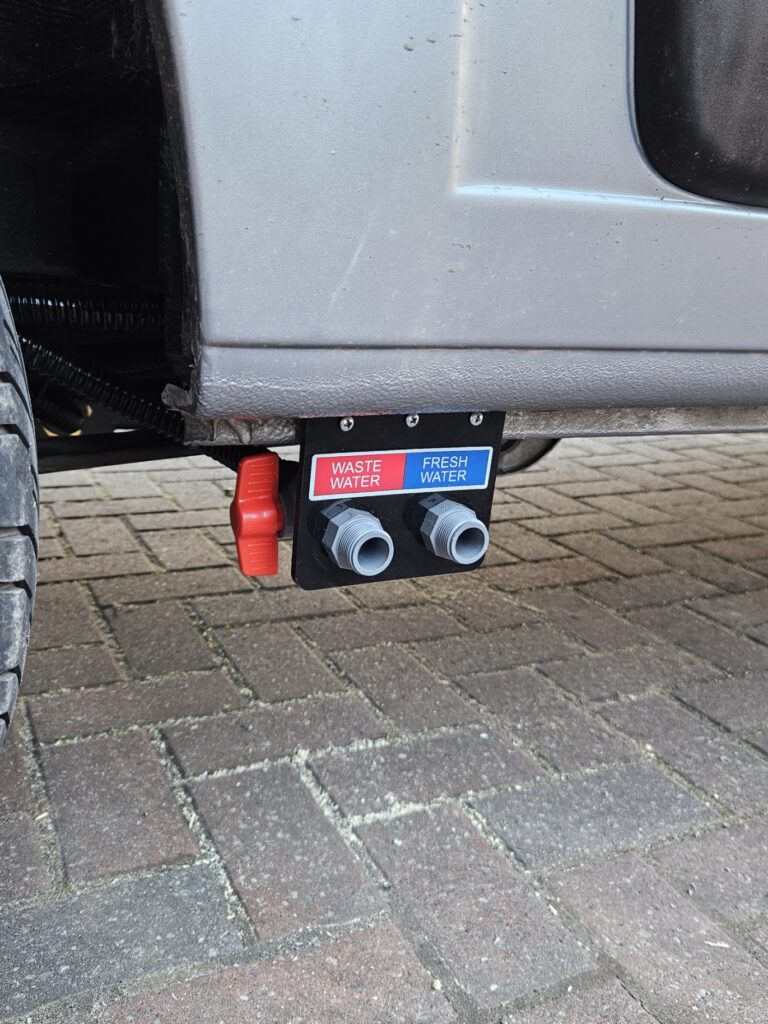
Tank Drain
The drain should be:
- Accessible
- Protected from road impact
- Positioned away from the exhaust
- Easy to operate
- Capable of emptying the low point of the tank
A remote drain extension can make an underslung tank much easier to use.
Pumps, Filters and Accumulators
A complete fresh-water system may include a pressure pump.
The pump should be matched to:
- Number of outlets
- Required flow
- Water-heater specification
- Pipework pressure rating
- Electrical supply
- Desired noise level
A filter or strainer is normally fitted before the pump to stop debris from the tank entering the pump mechanism.
An accumulator may be added to:
- Smooth water flow
- Reduce rapid pump cycling
- Reduce noise
- Store a small amount of pressurised water
Related troubleshooting guides include:
- Why Won’t My Campervan or Motorhome Water Pump Prime?
- Why Is Air Coming From My Campervan or Motorhome Taps?
- Why Does My Campervan Water Pump Keep Running?
Frost Protection
Underslung tanks and exposed pipes are vulnerable to freezing.
Possible measures include:
- Tank insulation
- Pipe insulation
- Tank-heating pads
- Trace heating
- Internal fresh-water storage
- Drain-down valves
- Winterising the system before storage
Insulation slows heat loss but does not generate heat.
An insulated underslung tank can still freeze during prolonged cold conditions.
Customers planning frequent winter use should consider whether an internal fresh-water tank would be more suitable.
Waste-water pipes and drain valves can also freeze, particularly where narrow sections remain full of water.
Installation and Mounting Safety
A full tank is a substantial load.
The mounting system must withstand:
- Tank weight
- Water movement
- Braking
- Cornering
- Road vibration
- Repeated filling
- Corrosion
- Long-term use
The tank should not:
- Hang below vulnerable chassis components
- Touch the exhaust
- Obstruct jacking points
- Restrict suspension movement
- Cover important service areas
- Interfere with brake or fuel lines
Where mounting holes are drilled, they should be positioned carefully and protected against corrosion.
Customer-Supplied Tanks
Customers are welcome to supply their own tank and mounting kit, subject to compatibility checks.
Before booking, send:
- Product link
- Tank dimensions
- Tank capacity
- Mounting instructions
- Photographs of the supplied brackets
- Vehicle make, model and year
- Wheelbase
- Underbody photographs
- Intended fresh or waste-water use
Additional fittings may still be required.
A kit described by a retailer as complete may not include every item needed for the intended installation.
Possible additional parts include:
- Filler hose
- Breather hose
- Tank outlet
- Drain extension
- Isolation valves
- Pipe adapters
- Clips
- Pump
- Filter
- Water-level sender
- Electrical cable
Indicative Labour Prices
The following prices are labour guides and assume reasonable access and compatible components.
| Installation | Labour from |
|---|---|
| Mount supplied vehicle-specific tank and bracket kit | £300 |
| Mount one tank with basic filler, breather, outlet and drain | £395 |
| Complete fresh-water tank connection to an existing system | £525 |
| Complete waste-water tank connection to existing pipework | £450 |
| Combined fresh and waste-water tank installation | £650 |
| Universal or custom-mounted tank | Quoted after assessment |
| Replacement of an existing damaged tank | Quoted after inspection |
Parts are additional unless specifically included in the quotation.
Prices may increase where:
- Brackets require alteration
- Existing equipment must be moved
- An external filler needs cutting into the body
- Furniture or flooring restricts access
- Additional wiring is required
- A level gauge is being installed
- Corrosion is present
- Custom fabrication is required
- Existing plumbing needs correcting
A final price is confirmed after reviewing the vehicle, tank and required connections.
Our Installation Process
1. Vehicle and Tank Assessment
We confirm:
- Vehicle make and model
- Year
- Wheelbase
- Tank dimensions
- Fresh or waste use
- Existing underbody equipment
- Required plumbing
2. Installation Plan
We decide:
- Tank position
- Mounting points
- Filler route
- Breather route
- Drain location
- Pump connection
- Waste-pipe route
3. Tank Installation
The tank is positioned and securely mounted using suitable brackets and fixings.
Underbody clearance is checked before the remaining connections are completed.
4. Plumbing
The agreed filler, breather, outlet, drain, pump or waste-water connections are installed.
5. Testing
The completed system is filled or tested as appropriate.
Checks may include:
- Mounting security
- Filler operation
- Breather operation
- Drain valve
- Pump operation
- Water flow
- Waste drainage
- Visible leaks
6. Handover
We explain the operation of the:
- Filler
- Pump
- Drain
- Tank gauge
- Winterisation procedure
- Cleaning and maintenance points
Water Tank Installation near Huddersfield
Customers travel from across Yorkshire, Lancashire, Greater Manchester and across the North of England.
The installer works on:
- Self-build campervans
- Professionally converted vans
- Factory campervans
- Motorhomes
- Part-completed conversions
- Existing water systems needing improvement
Learn more about our campervan water systems and plumbing services.
For leaks, pump faults or existing system problems, visit our campervan and motorhome repairs and fault-finding service.
Frequently Asked Questions
How much does it cost to install an underslung campervan water tank?
Mounting a supplied vehicle-specific tank and bracket kit starts from approximately £300 labour.
Mounting with filler, breather, drainage and outlet connections starts from approximately £395 labour.
A complete functioning system is quoted according to the vehicle and required plumbing.
Can you install a customer-supplied water tank?
Yes, subject to confirming compatibility and checking the tank, brackets and fittings.
Do you fit both fresh and waste-water tanks?
Yes.
The installer can install a fresh tank, waste tank or a combined system using two separate tanks.
Can you fit a tank to a Peugeot Boxer?
Yes, subject to confirming the model year, wheelbase, tank and available underbody space.
Do Boxer, Ducato and Relay tanks fit all three vehicles?
Some tanks are designed for the shared Boxer, Ducato and Relay platform.
The exact fit still depends on year, wheelbase, AdBlue equipment and mounting position.
Can you fit a water tank to a VW Transporter?
Yes, where a suitable tank and installation location are available.
Options may include an underslung, wheel-arch or internal tank.
Is an internal or underslung fresh-water tank better?
An underslung tank preserves internal storage.
An internal tank is usually easier to protect from freezing and may be better for frequent winter use.
Can you connect a tank to my existing water pump?
Usually, provided the pump, filter and pipework are suitable and in serviceable condition.
Can you fit a water-level gauge?
Yes, where a suitable sender and compatible display are available.
Can you repair an existing leaking tank installation?
Yes, subject to inspection.
Repairs may include fittings, pipework, drains, brackets or complete tank replacement.
Can you work on a campervan converted elsewhere?
Yes, subject to access and the condition of the existing installation.
Request a Campervan Water-Tank Installation Quote
To request a quotation, send us:
- Vehicle make and model
- Vehicle year
- Wheelbase
- Fresh or waste-water requirement
- Tank capacity
- Product link if already purchased
- Photographs of the tank and brackets
- Photographs beneath the intended mounting area
- Details of the existing pump and plumbing
- Whether an external filler is required
- Whether a level gauge is required
- Your postcode
Contact WeConvert to discuss campervan fresh or waste-water tank installation near Huddersfield, West Yorkshire.